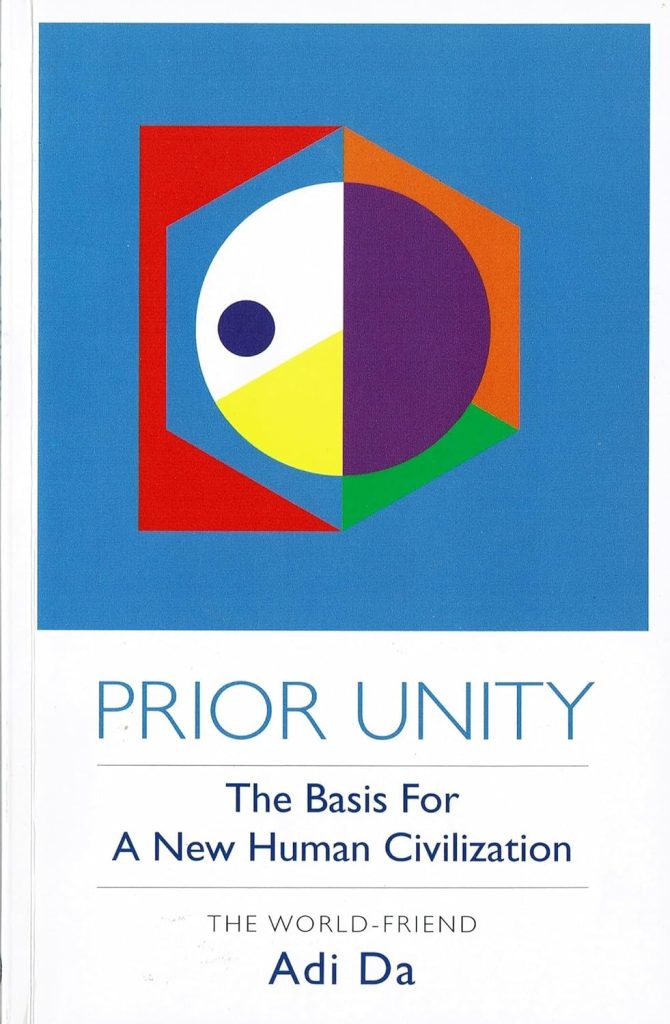
At a time when humanity faces profound social division and global instability, the question of unity has become urgent rather than theoretical. For the Ahimsa Peace Institute, this question has always been central. The concept of Prior Unity offers a foundational reframing of existence itself. It affirms that unity is not something humanity must construct through agreement, governance, or moral effort. Unity is the prior condition of reality. All beings, cultures, and systems arise within it.
This understanding stands at the heart of the spiritual revelation of Beloved Adi Da Samraj, who articulated Prior Unity not as a philosophical abstraction, but as a direct disclosure of Reality as it is. From this perspective, separation is not fundamental. It is an appearance generated by perception and self-identification. Difference unfolds within unity. It does not contradict it.
For peacebuilding informed by ahimsa, understood as a principle of non separation, this distinction is significant. Peace is not approached here as a corrective response to conflict, but as an expression of clarity about how existence is already constituted. From this perspective, peace emerges from accurate understanding rather than intervention or reform.
Unity Before Difference
Many prevailing worldviews begin with the assumption of separation. Individuals are understood primarily as autonomous selves. Nature is approached as external. Social systems are frequently organized around competition, management, and control. Within this orientation, unity is often treated as an aspirational outcome rather than a foundational condition.
Prior Unity introduces a different orientation. It affirms that unity precedes difference. Relationship is primary. Division is secondary. This is not a critique of people or cultures. It is a recognition of the assumptions that quietly shape modern institutions and policies.
When unity is understood as prior, patterns of human response may be examined through recognition rather than regulation. Within this orientation, compassion is not framed as a rule, value, or requirement, but as a descriptive feature of perception grounded in shared existence. Cooperation is understood as emergent rather than imposed, and care for others as contextual rather than obligated. This framing allows ahimsa to be understood as an orientation of awareness rather than a moral or ethical system.
Revelation Rather Than Attainment
A defining feature of Adi Da Samraj’s teaching is the insistence that Reality is revealed, not attained. In contrast to spiritual systems that emphasize progressive effort or self-mastery, Prior Unity is disclosed as always already present.
The obstacle to recognition is not lack of education or discipline, but the habitual contraction into a separate sense of self. This contraction gives rise to the experience of isolation and fragmentation. From the perspective of Ahimsa Peace Institute, this insight has direct implications for peace education.
From this perspective, conflict may be examined as arising from patterns of misidentification rather than from any fixed or inherent human condition.
Recognition replaces seeking. Relationship replaces technique. Devotion, understood as alignment with Reality, becomes the context in which contraction relaxes and clarity emerges.
Self-Contraction and the Appearance of Separation
If existence is a unified field, why does separation feel so real. Adi Da’s work identifies the mechanism as self-contraction. This contraction is the tendency to locate identity in a narrow point of awareness defined over and against the world.
From within this contraction, reality appears fragmented. Other beings are perceived as external. Nature becomes objectified. Conflict becomes normalized. Yet this contraction is not inherent to existence. It is a pattern of perception.
When patterns of contraction are examined, unity is not described as something newly established, but as something revealed through a shift in perception. Relationship may be experienced as more immediate and continuous. From this perspective, the world is understood not as something one stands apart from, but as something one participates in. This framing allows ahimsa to be understood as an expression of awareness rather than an ethical or behavioral position.
Prior Unity as the Basis for Peacebuilding
Prior Unity is not merely a metaphysical insight. It provides a foundation for peacebuilding that precedes ideology, policy, or negotiation. Without an accurate understanding of human nature and reality, peace efforts remain fragile and temporary.
When unity is recognized as prior, peace may be approached not primarily as a negotiated condition between opposing interests, but as an expression of shared existence. Systems informed by assumptions of separateness tend to reproduce division, while those informed by unity emphasize coordination, mutual recognition, and continuity. This distinction is relevant for peace education and dialogue, where the emphasis is on understanding rather than instruction or prescription.
This understanding finds applied expression in Adi Da Samraj’s work Not-Two Is Peace, which articulates how the recognition of Prior Unity can inform global cooperation and peacebuilding. While Prior Unity establishes the ontological ground, Not-Two Is Peace addresses how that ground may be expressed in human civilization and collective responsibility.
For readers engaged in peace education, policy, or community dialogue, this distinction clarifies the difference between peace as strategy and peace as expression of understanding.
A Living Context Within Global Wisdom
The recognition of unity appears across many wisdom traditions. Nondual philosophy in Advaita Vedanta, contemplative traditions within Buddhism, and mystical expressions in Sufism all point toward an indivisible ground of being.
Prior Unity resonates with these traditions while remaining distinct. It is not presented as the culmination of philosophical reasoning or disciplined practice, but as the fundamental condition disclosed through Divine Revelation. This orientation supports the Ahimsa Peace Institute’s commitment to education that integrates spiritual clarity with practical responsibility.
Conclusion. Recognition as Participation
Prior Unity is not an abstraction. It points to a way of seeing reality clearly and coherently. When unity is recognized as prior, experience is no longer framed through imposed structures of belief, idealization, or corrective intention. Unity is understood as the ground within which life unfolds, rather than an outcome to be achieved.
At a moment when humanity stands at a critical threshold, the recognition of Prior Unity offers not an escape from the world, but a clearer understanding of how the world is already constituted. Not belief, but clarity. Not ideology, but ground. Within this recognition, participation replaces separation and continuity replaces division. This orientation reflects ahimsa as an expression of awareness in our time.
References
Adi Da Samraj. Not-Two Is Peace. The Ordinary People’s Way of Global Cooperative Order. Dawn Horse Press. https://www.nottwoispeace.org
Prior Unity Project. Prior Unity. https://www.priorunity.org
Deutsch, Eliot. Advaita Vedanta. A Philosophical Reconstruction. University of Hawaii Press.
Nasr, Seyyed Hossein. Knowledge and the Sacred. State University of New York Press.
Study and Reflection Prompts
These prompts may be used for individual reflection, classroom discussion, peace circles, or community dialogue.
1. Reflection on Unity
How does the idea that unity is the prior condition of existence differ from the idea of unity as a future goal or outcome?
2. Perception and Experience
Where do you notice experiences of separation arising in your own perception. How might these relate to patterns of self contraction rather than external conditions?
3. Peace and Understanding
How does understanding peace as an expression of shared existence differ from understanding peace as a strategy or solution?
4. Systems and Assumptions
What assumptions about separation or unity appear to shape modern institutions and social structures?
5. Ahimsa as Orientation
How might ahimsa be understood as an orientation of awareness rather than a rule, value, or moral directive.
Study Guide
Prior Unity and the Practice of Ahimsa
Purpose
This study guide accompanies the blog post Prior Unity. The Ground of Peace, Consciousness, and Human Continuity. It is designed to support reflection, dialogue, and practical application of Prior Unity as a foundation for ahimsa, peacebuilding, and responsible participation in the world.
Core Insight
Prior Unity affirms that unity is not a goal to be achieved, but the prior condition of existence itself. All beings, cultures, and systems arise within this unity. Separation is not fundamental. It is an appearance shaped by perception and self-identification. For the Ahimsa Peace Institute, this insight is essential. Sustainable peace cannot be built upon a misunderstanding of human nature. Non harm is understood here as descriptive of clarity, not as a system of enforcement.
Key Themes for Study
• Unity precedes difference
• Separation arises through self-contraction
• Peace is an expression of shared existence
• Patterns of response emerge from recognition rather than obligation
• Ahimsa is grounded in awareness, not restraint
Reflection Prompts
1. Understanding Unity
How does the idea that unity is the prior condition of reality differ from the idea of unity as a future goal or moral aspiration?
2. Self-Awareness
Where do you notice a sense of separation in your own experience. How might this reflect a pattern of perception rather than an objective condition?
3. Ethics and Non Harm
If compassion arises from recognition rather than obligation, how does this change your understanding of moral responsibility and ethical action?
4. Peacebuilding
How might peace efforts change if they were grounded in the recognition of Prior Unity rather than negotiation between competing interests?
5. Daily Practice of Ahimsa
In what ways can the recognition of Prior Unity inform everyday choices in speech, relationships, and community engagement?
Application
Consider one concrete way you can express ahimsa this week by acting from recognition of unity rather than reaction to perceived separation.
Discussion Questions for Group Dialogue
These questions are intended for classrooms, peace circles, faith communities, nonprofit leadership groups, or UN aligned discussions.
1. What assumptions about separation or unity appear to shape contemporary social, political, or economic systems?
2. How does the concept of self contraction help explain recurring patterns of conflict at personal or collective levels?
3. In what ways does Prior Unity differ from conventional frameworks used in peacebuilding or governance?
4. How does shifting from obligation to recognition change how peace and cooperation are discussed?
5. How might education change if unity were understood as foundational rather than aspirational?
6. What does participation mean when existence is understood as a shared field rather than a collection of separate entities?






Very interesting! But a nonviolent upbringing of children must also be guaranteed. According to peace researcher Franz Jedlicka it has an impact on the peacefulness of nations.
Gregory
Awesome! It’s a genuinely remarkable post.